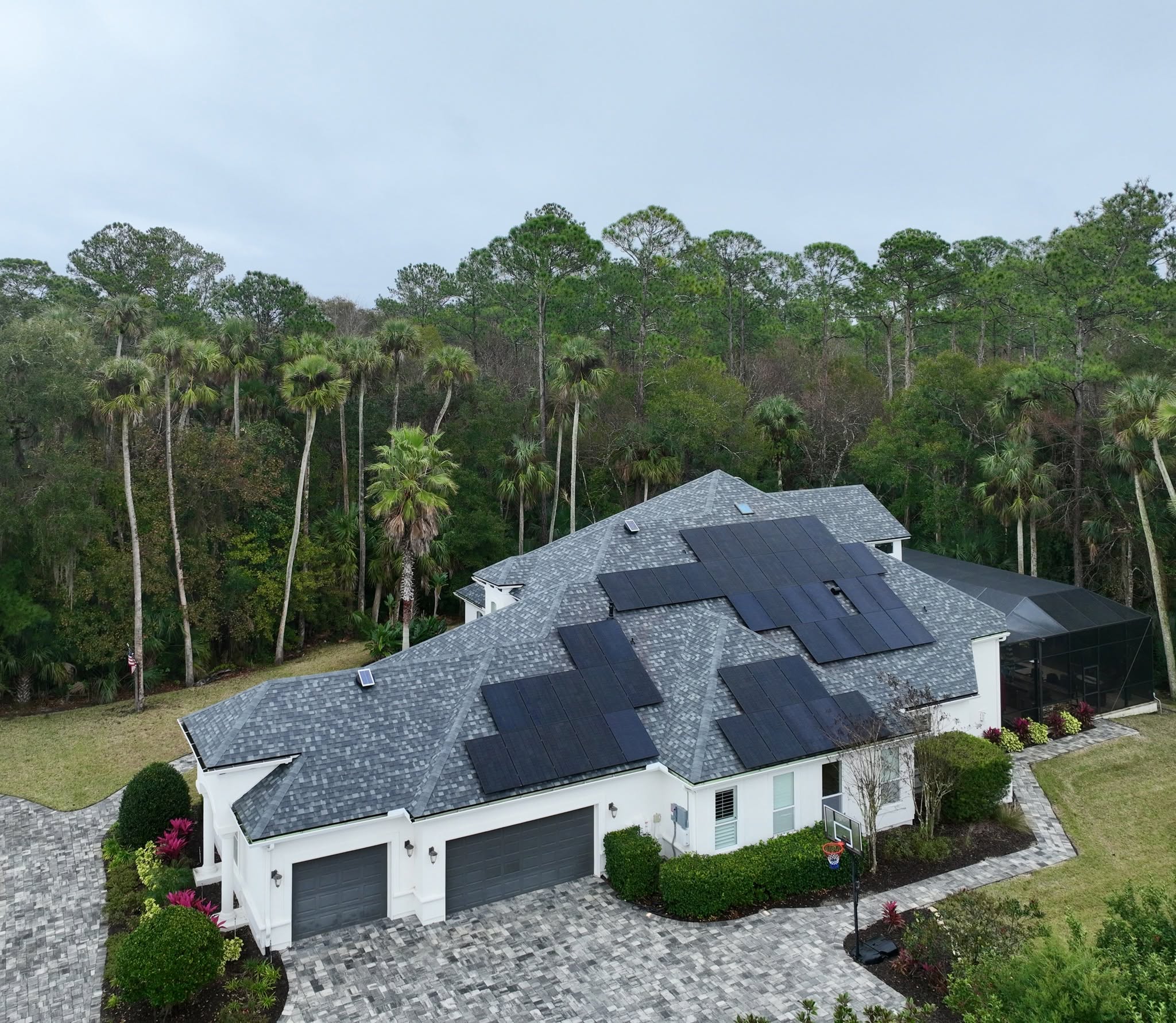
A local installer’s honest take on solar in 2026 — what changed, what didn’t, and why the math still works.
If you’ve been researching solar panels lately, you’ve probably seen the headlines: The federal solar tax credit is gone for homeowners. And that’s true. The One Big Beautiful Bill Act ended the Section 25D residential solar tax credit on December 31, 2025. For a homeowner installing a $30,000 system, that’s roughly $9,000 that no longer comes back as a tax refund.
That’s a real loss. We’re not going to sugarcoat it.
But here’s what the headlines aren’t telling you: the tax credit was never the reason solar works in Florida. It made payback faster — sometimes by three or four years — but the core value of solar has always been the same. You generate your own electricity instead of buying it from a utility whose prices go up every single year.
We’ve been installing solar in Gainesville and across Florida for 17 years — through three different versions of the federal solar tax credit. Every time the incentive changed, the same question came up: “Is it still worth it?” Every time, the answer was yes. Here’s why 2026 is no different.
What Actually Changed — and What Didn’t
The Federal Change: OBBBA in Plain English
The One Big Beautiful Bill Act (OBBBA), signed into law on July 4, 2025, made one significant change for homeowners considering solar:
- Section 25D residential solar tax credit: eliminated. If you buy a solar system with your own money or through a loan, you can no longer claim 30% back on your federal taxes. This credit had been available in some form since 2006.
- Section 48E investment tax credit: still alive. This is the credit available to solar companies that own the system and lease it to you. Under a solar lease, the leasing company claims the 30% credit and passes the savings to you through a lower monthly payment. This credit is available through at least December 2027.
So if you heard that “all solar tax credits are gone,” that’s not accurate. The homeowner credit is gone. The business credit — which benefits you through a lease — is still here for at least another year and a half.

What Did NOT Change in Florida
Federal policy shifted. Florida’s solar incentives didn’t move an inch:
- 100% property tax exemption — your solar system is completely exempt from property taxes under Florida Statute 193.624. A $25,000 system that adds value to your home? Zero additional property tax.
- Sales tax exemption — Florida waives the 6% state sales tax on solar energy equipment, including panels, inverters, batteries, and mounting hardware. On a $20,000 system, that’s $1,200 you don’t pay.
- 1:1 net metering — FPL, Duke Energy and TECO all offer full retail-rate credit for every excess kilowatt-hour your solar panels send to the grid. This hasn’t changed, and it’s the single biggest reason solar pays off in Florida.
- 230+ days of sunshine per year — definitely untouched.
The bottom line: one federal incentive ended. Every Florida incentive is still intact. And the financial case for solar depends far more on what your utility charges than what government offers.
Your Electric Bill Is About to Get a Lot Worse
This is the part most solar articles skip — and it’s the most important part of the equation.
The $7 Billion Rate Hike
In November 2025, the Florida Public Service Commission approved one of the largest utility rate increases in American history: a $7 billion rate hike for Florida Power & Light, phased in over four years.
Here’s the timeline:
- 2026: $945 million base-rate increase
- 2027: $705 million base-rate increase
- 2028–2029: Additional billions for grid expansion, utility-scale solar, and battery storage projects
This affects 5.8 million customer accounts — roughly half the state.
For a residential customer using 1,000 kilowatt-hours per month (a standard benchmark, though many Florida homes use much more), here’s what the trajectory looks like:
| Year | Approx. Monthly Bill (1,000 kWh) | What’s Driving It |
| 2020 | ~$96 | Pandemic-era relief and cheap fuel |
| 2022 | ~$120 | Global natural gas price surge |
| 2023 | ~$143 | Hurricane Ian and Nicole recovery surcharges |
| 2025 | ~$134 | New surcharges for Hurricanes Debby, Helene, and Milton |
| 2026 | ~$137 | Approved base-rate increase begins |
| 2027 | ~$143 | Second phase of base-rate increase |
| 2029 | ~$148+ | Cumulative increases plus solar/battery pass-throughs |
That’s a 45% increase from 2020 to 2026 — and it’s not slowing down.
The Hidden Charges on Your Bill: Fuel Adjustments and Storm Surcharges
Here’s something most people don’t realize: the “$7 billion rate hike” only covers the base rate — one component of your bill. Your total electricity charge is actually built from several separate line items, and some of them are volatile.
Here’s how FPL breaks down a residential kilowatt-hour as of January 2026:
| Charge | Rate (¢/kWh) | What It Is |
| Base energy charge | 7.865¢ | Cost of generating and delivering power |
| Fuel charge | 2.893¢ | Direct pass-through of natural gas costs |
| Storm protection | 0.995¢ | Grid hardening and storm preparation |
| Environmental | 0.345¢ | Environmental compliance |
| Conservation | 0.148¢ | Energy efficiency programs |
| Capacity | 0.052¢ | Generation capacity reserve |
| + Monthly base charge | $10.52/mo | Fixed service charge |
That fuel charge is the one to watch. It’s a direct pass-through of what FPL pays for natural gas — the primary fuel for Florida’s power plants. FPL doesn’t mark it up, but they don’t absorb it either. When global gas prices spike, so does your bill. In 2022, that fuel charge was the main reason FPL bills jumped 19% in a single year.
Then there are storm surcharges. After the 2024 hurricane season (Debby, Helene, and Milton), Tampa Electric added approximately $20 per month to residential bills just for storm recovery. That surcharge is temporary — it comes off in September 2026 — but it shows how quickly your bill can jump after a bad storm season.
And it’s not just FPL. Here’s how other Florida utilities stack up in 2026:
| Utility | 2026 Bill (1,000 kWh) | What’s Happening |
| FPL | ~$137/mo | Rising through 2029 |
| TECO (Tampa) | ~$177/mo | +$8.88 in Jan; storm surcharge drops in Sep |
| Duke Energy FL | Dropping ~$44 in Mar | Temporary relief — storm charges removed |
| GRU (Gainesville) | Fuel adj: 3.5¢/kWh | Plus 2.5% gross receipts tax on all charges |
| JEA (Jacksonville) | +5.1% in FY2026 | Base and fuel both rising |
Why This Is the Real Case for Solar
Solar panels produce electricity with zero fuel cost. No natural gas. No fuel adjustment charge. No pass-through.
Every kilowatt-hour your system generates offsets all of these per-kWh charges — the base rate, the fuel charge, the storm protection fee, everything. When natural gas prices spike next winter, your panels don’t care. When the next hurricane triggers a recovery surcharge, you’re insulated.
You’re not just saving money at today’s rates. You’re locking in your energy cost for 25 to 30 years while your neighbors’ bills keep climbing.
The Math Still Works — Here’s the Proof
What Does Solar Cost in Florida Right Now?
As of April 2026, the average installed cost of residential solar in Florida ranges from $2.19 to $2.71 per watt, according to EnergySage and SolarReviews.
For a typical Florida home:
| System Size | Estimated Installed Cost | Best For |
| 8 kW | $17,500 – $21,700 | Moderate usage (1,000 kWh/mo) |
| 10 kW | $22,000 – $27,100 | Higher usage or future EV charging |
| 12 kW | $26,300 – $32,500 | Large home or full offset goal |
Florida’s sales tax exemption saves you $1,200 to $2,000 right off the top — that’s baked into these numbers.
Payback Period: The Real Florida Numbers
You may have seen the statistic that solar payback periods extend to 15.5 years without the federal credit. That number comes from EnergySage and uses national averages — including states with far less sunshine and higher installation costs than Florida.
When you factor in Florida’s actual sun hours, current utility rates, and the trajectory of those rates through 2029, a well-sized cash-purchase system typically pays for itself in 9 to 13 years — still well under half the system’s 25 to 30 year operational lifespan.
That means 12 to 19 years of essentially free electricity after payback. For a system offsetting $150/month in utility bills, that’s $21,600 to $34,200 in lifetime savings after the system has already paid for itself.

The 48E Alternative: Going Solar Through a Lease
If paying upfront isn’t in the cards, the Section 48E credit creates a compelling option. Here’s how it works:
A solar company installs a system on your roof and retains ownership. Because they own it, they can claim the 30% federal investment tax credit — the one that’s still available for businesses through at least December 2027. They pass that savings to you as a lower monthly lease payment.
The advantages:
- No upfront cost — $0 down
- Predictable monthly payment, typically lower than your current electric bill
- The 30% credit effectively still applies to your system — just through a different path
- Maintenance is typically included
The trade-offs:
- You don’t own the system
- No production guarantee in many lease agreements
- May leave you paying both the electric bill and solar lease if production drops
- Can’t claim the property value increase for refinancing purposes
- May complicate or delay the home selling process
This path works best for homeowners who want solar savings without a large upfront investment — and it’s available right now through.
Battery Storage: The Game-Changer for 2026
If there’s one piece of the solar equation that’s changed the most since the tax credit ended, it’s battery storage. Here’s why batteries matter more now than ever.
Why Add a Battery?
Without a battery, your solar panels are a bill reducer. They offset your electricity costs, but you’re still connected to and dependent on the grid. When the power goes out, your panels shut down too — it’s a safety requirement.
With a battery, your solar system becomes something different: energy independence. You store daytime solar for evening use, reducing how much electricity you buy from the grid. You’re less exposed to fuel adjustment swings. And when a hurricane knocks out power for your street, your lights stay on.
In a state where hurricane season starts June 1 and where storm recovery surcharges regularly add $20+/month to utility bills, that backup capability has real financial — and personal — value.
The Tesla Powerwall Rebate: Order Before June 30
Tesla’s “Next Million” program offers a $500 rebate per Powerwall unit (up to $1,000 for two units). The order deadline is June 30, 2026.
A Powerwall 3 typically costs $11,000 to $16,500 installed. With the rebate, you’re looking at $10,500 to $16,000.
For homeowners who’ve been on the fence about adding a battery, this is the clearest window of opportunity we’ve seen this year.
Your Battery Options
We install all three of the leading residential battery systems:
- Tesla Powerwall 3 — 13.5 kWh capacity, integrated solar inverter, industry-leading app and monitoring
- FranklinWH aPower S — modular design, whole-home backup capable, works with any inverter
- Enphase IQ Battery 5P — microinverter-native, scalable in small increments, strong monitoring
The right choice depends on your home’s electrical setup, your utility, and your goals. We can walk you through the comparison for your specific situation.
Why Your Installer Matters More Than Your Incentives
The solar industry just went through its biggest shakeout in a decade. In 2025, Sunnova — one of the largest residential solar companies in the United States — filed for bankruptcy. ADT Solar exited the market entirely. Mosaic, a major solar lender, restructured its operations.
Thousands of Florida homeowners were left with orphaned solar systems: panels on their roof, no warranty support, no monitoring, and no one to call when something goes wrong.
This is the part of going solar that doesn’t show up in a payback calculator. The company you choose today is the company you’ll need in year 5 when an inverter fails, in year 10 when you want to add a battery, and in year 15 when a panel needs replacement.
PPM Solar has been installing solar in Florida since 2009. We’ve worked through three different tax credit regimes, multiple hurricane seasons, and every supply chain disruption of the past decade. We’re still here — and our monitoring and service team is still supporting every system we’ve ever installed.
When the incentives change, the installers who built their business on incentive-driven sales are the first to disappear. The ones who built on quality and service are the ones still answering the phone.
Let’s Run the Numbers for Your Home
Every home is different. Your roof orientation, your utility provider, your monthly electricity usage, and your budget all factor into the calculation. A system that pays back in 11 years for your neighbor might pay back in 9 for you — or 14.
We’ve been doing this in Florida for 17 years. We’ll give you the honest picture — what solar will cost, what it will save, and whether it makes sense for your situation.
Get your savings report with our Florida-tailored calculator tool and schedule your free solar consultation.
Frequently Asked Questions
Can I still get the solar tax credit in Florida in 2026?
The Section 25D homeowner tax credit ended on December 31, 2025. However, the Section 48E investment tax credit is available through solar leases until at least December 2027 — the leasing company claims the credit and passes the savings to you. Florida’s property tax exemption and sales tax exemption on solar equipment remain fully available regardless of federal changes.
How long do solar panels take to pay for themselves in Florida?
Without the federal credit, a well-sized system in Florida typically pays for itself in 11 to 13 years, thanks to high sun exposure, 1:1 net metering, and rising utility rates. With a solar lease (which captures the 48E credit), you can see savings from month one since there’s no upfront cost.
Are solar panels still a good investment without the tax credit?
Yes. The tax credit accelerated payback but didn’t create the underlying value. Solar’s core benefit — offsetting electricity costs that rise every year — hasn’t changed. Florida electricity bills have risen 45% since 2020, and FPL’s $7 billion rate increase is still phasing in through 2029. Solar panels generate power for 25 to 30 years, meaning the vast majority of their value comes after the payback period ends.
Will solar panels increase my property taxes in Florida?
No. Florida law provides a 100% property tax exemption for residential solar energy systems (Statute 193.624). Your home’s market value increases, but your property taxes do not.
Is it worth adding a battery to my solar system?
For storm backup alone, most Florida homeowners say yes — especially with hurricane season starting June 1. But batteries also increase your energy independence and reduce your exposure to volatile fuel adjustment charges on your utility bill. The Tesla Powerwall rebate ($500/unit, order by June 30, 2026) makes this the best time we’ve seen to add storage.