Florida is the second-largest EV market in the country. Over 1.1 million electric vehicles and hybrids are already on the road, with 250,000+ new registrations in 2025 alone.
Your employees are driving them. Your customers are driving them. Your tenants are driving them.
The question for Florida businesses isn’t whether you’ll need EV charging — it’s whether you’ll power it with solar or keep paying utility rates that just climbed by $7 billion.
This guide covers the full picture: federal and utility incentives you can stack, why solar makes commercial EV charging dramatically cheaper, and how to get from idea to first charge.
One note before we dive in: the largest federal incentive — up to $100,000 per charging port — expires June 30, 2026.
Why Florida Businesses Are Adding EV Charging Now
This isn’t about being green. It’s about three hard business realities.
Employee and Tenant Demand
Workplace charging is the second most common charging location after home — and the fastest-growing segment. According to PwC, workplace charge points will grow from near-zero to 17% of all charging infrastructure by 2030.
72% of employees without workplace charging say they want it (Plug In America). For businesses competing for talent, EV charging is becoming as expected as good Wi-Fi.
Property Value
Properties with EV charging infrastructure see 10–20% higher valuations. Commercial tenants increasingly require it in lease negotiations. For retail and hospitality, EV drivers spend more time — and more money — while their vehicle charges.
Revenue Opportunity
Businesses can charge for charging. FPL’s public DCFC rate is $0.45/kWh in 2026. A well-placed fast charger doesn’t just serve your team — it turns a parking lot into a profit center.
For fleet operators, the math is even simpler: electricity costs a fraction of diesel or gasoline per mile, and solar makes it cheaper still.
The Incentive Stack: Act Before June 30
Multiple federal and utility incentives can be layered on top of each other — and several have hard deadlines.
Federal: Section 30C — Up to $100,000 Per Port
Deadline: June 30, 2026
The Alternative Fuel Vehicle Refueling Property Credit (Section 30C) covers 30% of total commercial EV charging installation costs — equipment, labor, and materials — up to $100,000 per charging port.
Requirements:
- Your business must be in an eligible census tract (low-income or non-urban). Use the IRS census tract lookup tool to check.
- Prevailing wage requirements apply for the full 30% rate.
- Equipment must be placed in service by June 30, 2026.
The OBBBA moved this deadline forward from December 2032. That leaves roughly six weeks.
Federal: Section 48E — 30% ITC on the Solar System
The commercial solar investment tax credit is still available. Businesses claim up to 40% of the solar system cost, plus accelerated depreciation applied in year 1 — which together can reduce the effective cost of your solar installation by 50% or more.
Key point: 48E covers the solar system. 30C covers the EV charging infrastructure. They stack.
Learn more: Commercial Solar Tax Credit Guide
Duke Energy: Charger Prep Credit
Duke Energy Florida offers a one-time credit to business customers for the electrical infrastructure needed to support EV charging — wiring, outlets, panel upgrades, and other electrical work required for Level 2 or higher chargers.
- Business customers: up to $2,500 per Level 2 charging port for public-facing stations
- Does not cover charger hardware, software, or permits — only the electrical prep work
Duke also offers the Fleet Advisory Program: up to $12,000 to offset the cost of a professional fleet electrification study. Eligible if you operate 20+ light-duty or 5+ medium/heavy-duty vehicles.
FPL: EVolution Make-Ready Credit
FPL’s program covers utility-side electrical infrastructure — transformers, service lines, conduit, and switchgear. Credit amounts depend on charger capacity:
| Charger Type | Capacity | Credit Per Port | Site Cap |
| DCFC | 50–149 kW | Up to $20,000 | $120,000 |
| DCFC | 150–249 kW | Up to $30,000 | $180,000 |
| DCFC | 250 kW+ | Up to $50,000 | $300,000 |
| Level 2 | Public/workplace/fleet | Up to $1,200 | — |
This program is first-come, first-served. Once the budget is depleted, credits are no longer available.
JEA (Jacksonville)
- Level 2 (3–10 kW): $850 per port
- DCFC (50+ kW): $3,000 per port
What Stacking Looks Like: A Real Example
A business in Duke Energy territory installing 4 Level 2 ports alongside a 50 kW solar system:
| Component | Gross Cost | Incentives | Net Cost |
| Solar system (50 kW) | ~$100,000 | 48E ITC (−$30K) + MACRS (−$20K) | ~$50,000 |
| EV charging (4× L2) | ~$40,000 | 30C credit (−$12K) + Duke Prep (−$10K) | ~$18,000 |
| Total | ~$140,000 | −$72,000 | ~$68,000 |
That’s a 51% reduction — before counting a single kWh of energy savings.
Why Solar + EV Charging Beats Grid-Only
The Demand Charge Problem
Florida commercial electricity averages about 11¢/kWh for energy. That sounds reasonable — until you factor in demand charges.
Demand charges ($10–15 per kW) are based on your highest 15-minute peak usage in a billing cycle. A single DCFC unit can spike your demand by 50–150 kW, adding $500–$2,000 per month to your bill regardless of how much total energy you use.
How Solar Solves It
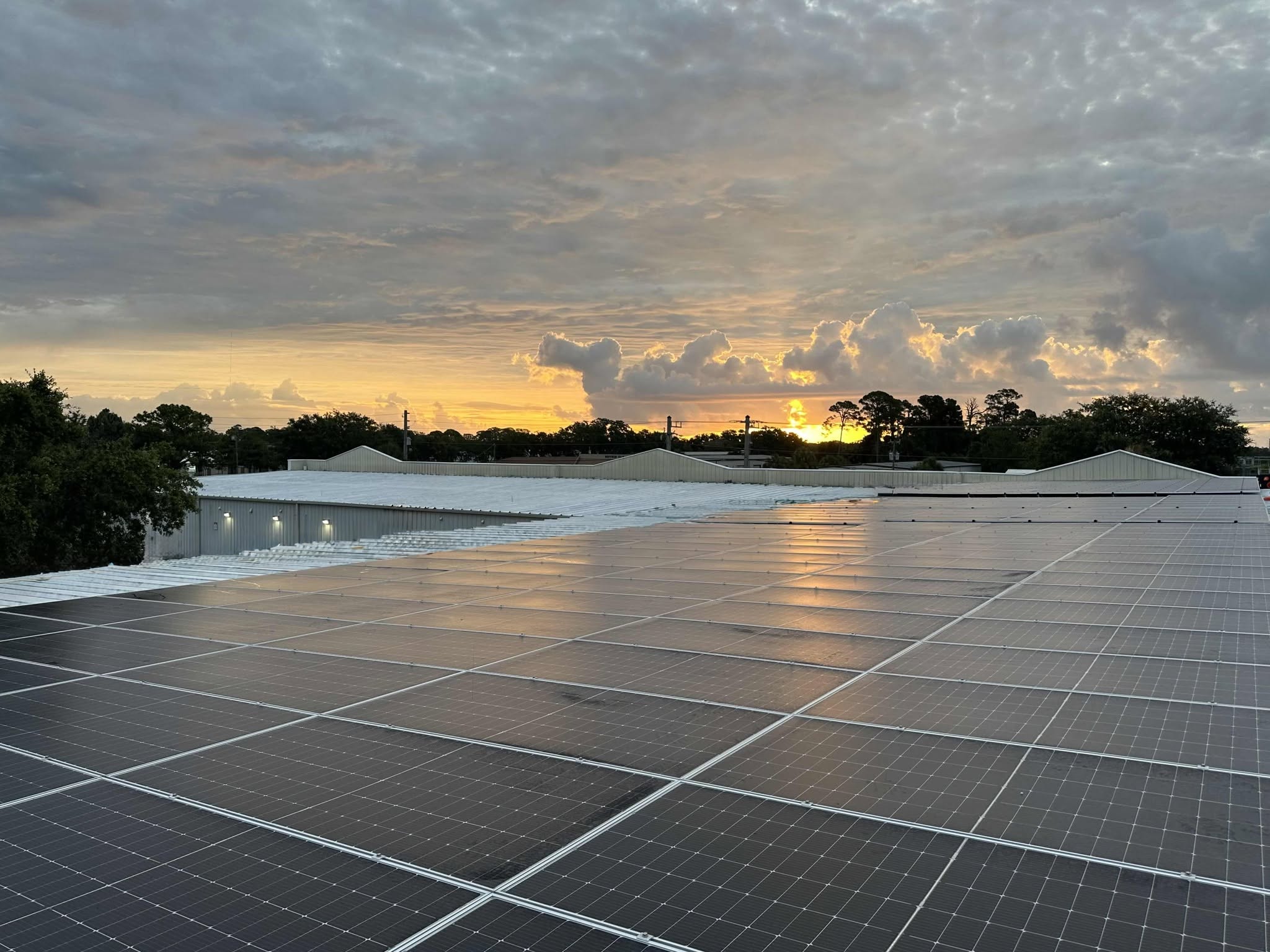
Solar panels generate peak power during midday — exactly when commercial demand (and demand charges) peak. This alignment:
- Shaves demand peaks → lower demand charges
- Offsets energy charges → lower per-kWh costs
- With battery storage → charge batteries during solar peak, discharge during EV demand spikes, flattening the demand curve entirely
Long-Term Cost Certainty
Florida utility rates are climbing. FPL’s $7 billion rate hike is just the base rate — fuel adjustment charges (tied to volatile natural gas prices) and storm surcharges stack on top.
Solar locks in your energy cost for 25+ years. No fuel adjustments. No rate surprises.
Hurricane Resilience
Solar + battery + EV charging creates microgrid capability. Keep your fleet vehicles charged during grid outages. Maintain business continuity when it matters most.
What Your Business Needs: Level 2 vs. DCFC
The right charger depends on how long vehicles are parked at your location.
| Business Type | Best Fit | Why |
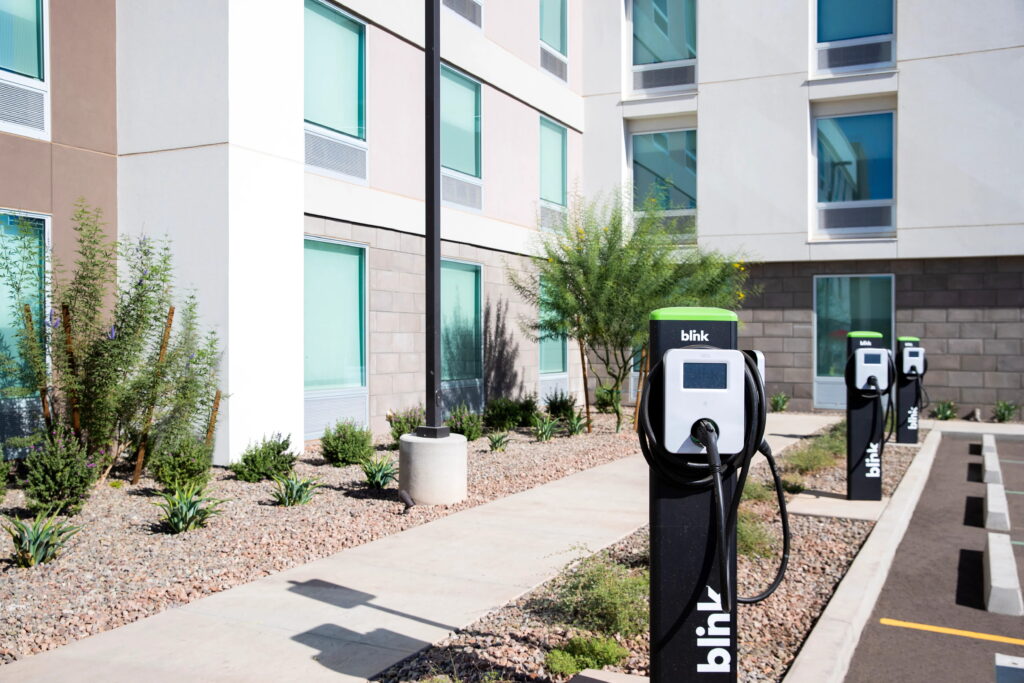
| Office / Workplace | Level 2 (7–19 kW) | Employees park 6–8 hrs; L2 fully charges during workday |
| Retail / Hospitality | L2 + DCFC mix | Some visitors stay 1–2 hrs (DCFC), others longer (L2) |
| Fleet Depot | L2 overnight + DCFC midday | Routine overnight L2; DCFC for quick turnaround |
| Multifamily / HOA | Level 2 | Residents charge overnight; cost-effective at scale |
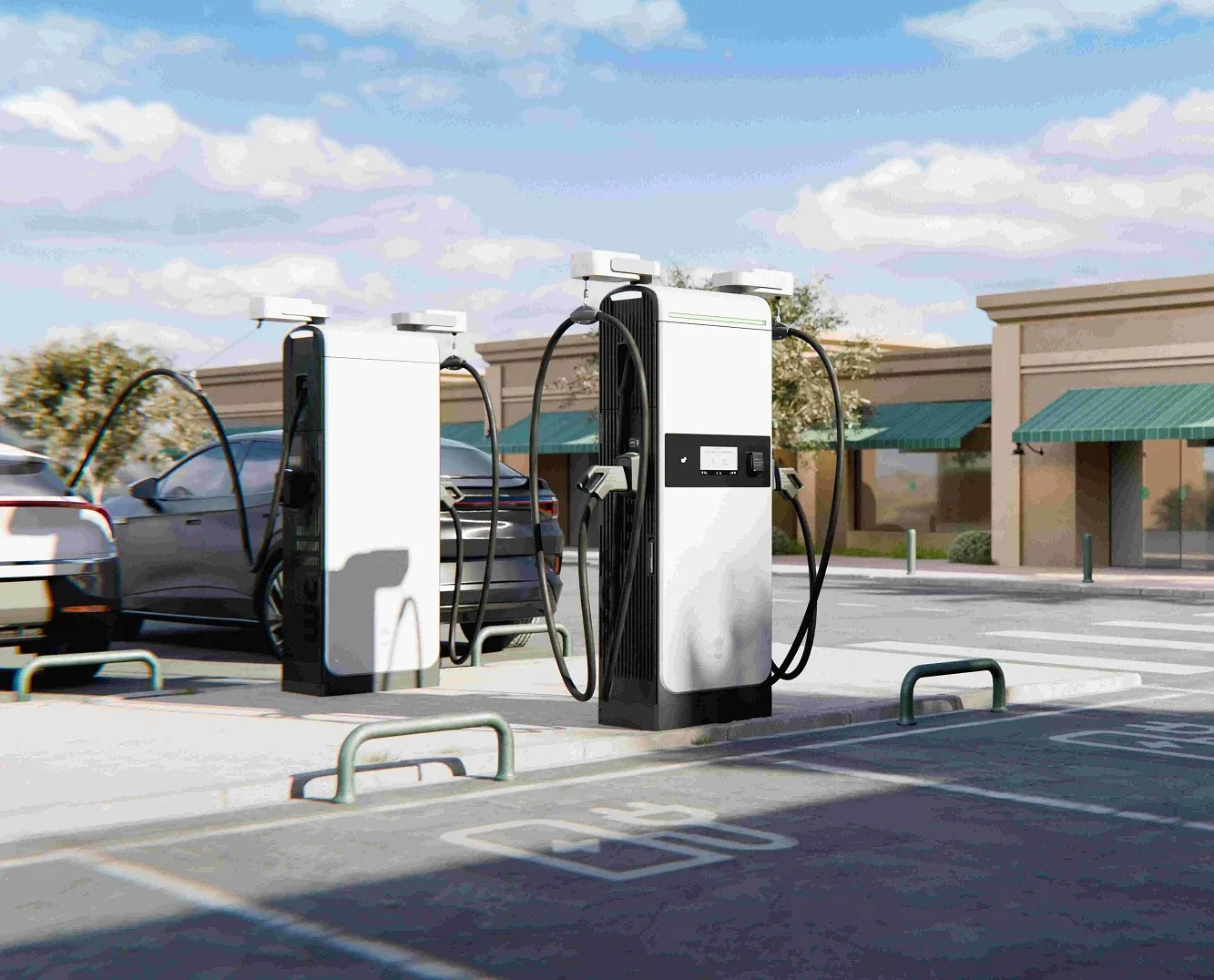
| Gas Station / C-Store | DCFC (150+ kW) | Drivers need 15–30 minute fast charges |
Cost Ranges
- Level 2: $3,500–$15,000 per port installed
- DCFC (50–149 kW): $18,000–$80,000 per port
- DCFC (150+ kW): $80,000–$350,000+ per port
Solar Sizing — Rules of Thumb
- Each L2 port at typical utilization ≈ 30–50 kWh/day → 8–12 kW of solar
- Each DCFC at moderate utilization ≈ 200–400 kWh/day → 50–100 kW of solar
- Battery storage is recommended with DCFC to manage demand charge spikes
PPM sizes every system to your actual demand profile, utility rate structure, and available roof or ground space.
From Site Assessment to First Charge
PPM handles the entire process — solar, electrical, and EV charging — with no subcontractors.
1. Site Assessment & Energy Audit — Evaluate your roof or parking area, existing electrical infrastructure, utility interconnection, and energy demand profile.
2. System Design — Size the solar array and charger count based on your demand, budget, and incentive eligibility. We check 30C census tract qualification for you.
3. Incentive Applications — We handle the paperwork: 30C documentation, Duke/FPL/JEA credit applications, 48E ITC filing, and MACRS depreciation setup with your accountant.
4. Permitting & Engineering — All done in-house. No subcontractor delays.
5. Installation — Solar panels, electrical infrastructure, and charger hardware. Typical commercial timeline: 4–8 weeks.
6. Commissioning & Interconnection — Utility approval, system testing, and monitoring setup.
7. Ongoing Monitoring & Service — PPM’s service team monitors system performance and handles maintenance so your system keeps producing.
Let’s Design Your EV + Solar System
Every commercial property is different. PPM has been installing commercial solar in Florida since 2009 — and now we pair it with EV charging for a single, integrated system.
Here’s what a free site assessment covers:
- Property evaluation (roof, parking, ground mount options)
- Utility rate analysis and demand charge review
- 30C census tract eligibility check
- Incentive stacking roadmap with projected ROI
- Custom system design and timeline
Schedule a Free Commercial Assessment
Frequently Asked Questions
How much does commercial EV charging with solar cost in Florida?
It depends on charger type and count. Level 2 ports run $3,500–$15,000 each; DCFC units start at $18,000. With incentive stacking (30C + 48E + utility credits), total out-of-pocket can be reduced 40–60%. Schedule a site assessment for a detailed quote.
Can I get the 30C tax credit for EV chargers at my business?
Yes — if your location is in an eligible census tract and equipment is placed in service by June 30, 2026. The credit covers 30% of costs, up to $100,000 per port. Check your eligibility with the IRS census tract lookup tool.
Does Duke Energy offer EV charging incentives for businesses?
Yes. The Charger Prep Credit covers electrical infrastructure costs — up to $2,500 per Level 2 port. The Fleet Advisory Program provides up to $12,000 for fleet electrification studies. These are separate from the federal 30C credit and can be stacked with it.
How many solar panels do I need to power EV chargers?
Rule of thumb: 8–12 kW of solar per Level 2 port at typical utilization, or 50–100 kW per DCFC. PPM sizes every system to your actual demand profile, roof or land availability, and utility rate structure.
Will EV charging increase my commercial electricity demand charges?
It can — significantly. A single DCFC unit can add $500–$2,000/month in demand charges alone. Solar panels generate peak power during peak demand hours, directly reducing these charges. Adding battery storage can virtually eliminate the demand charge spike.